

Managing revenue in Salesforce doesn’t have to be complicated. Many businesses struggle with scattered data and time-consuming manual processes, but there’s a simple solution. SAASTEPS brings together forecasting, quoting, subscription management, automated billing, and renewals lifecycle management with flawless AI-ready data in one easy-to-use app. Think of it as your revenue command center. They take messy, scattered, unstructured information and turn it into more precise, valuable, structured data with insights. Teams across your company can work together smoothly on quotes, bills, and renewals, making the whole process run like clockwork. Whether you’re a small business or a large corporation, SAASTEPS fits right into your existing Salesforce setup with minimal fuss. The best part? You’ll know exactly what you’re paying for, with no hidden costs or surprises.
Why Trust Our Revenue Management Expertise?
At SAASTEPS, we’ve been pioneering Revenue Lifecycle Management (RLM) solutions since 2012, transforming how businesses handle their entire revenue operations. Our co-founders, Tim Beck and Ron Costa, bring over two decades of industry experience specifically focused on solving the complexities of revenue management in the Salesforce ecosystem. This deep expertise has led to our development of a non-provisional patent-pending solution that’s future-proofing how companies approach their revenue lifecycle.
Our expertise isn’t just theoretical; we’ve helped numerous organizations achieve remarkable results, including reducing Days Sales Outstanding (DSO) from 30 days to just 2 days through our unified revenue management approach. Our clients have experienced up to a 250% increase in revenue clarity and 5x faster decision-making capabilities, thanks to our innovative single-data model connecting Pre-Sales and Post-Sales teams to work cohesively. These achievements stem from our unique understanding of the challenges businesses face in managing their revenue operations, which we’ve gained through working with diverse organizations across various industries.
Essential Features Every Salesforce Revenue App Should Have
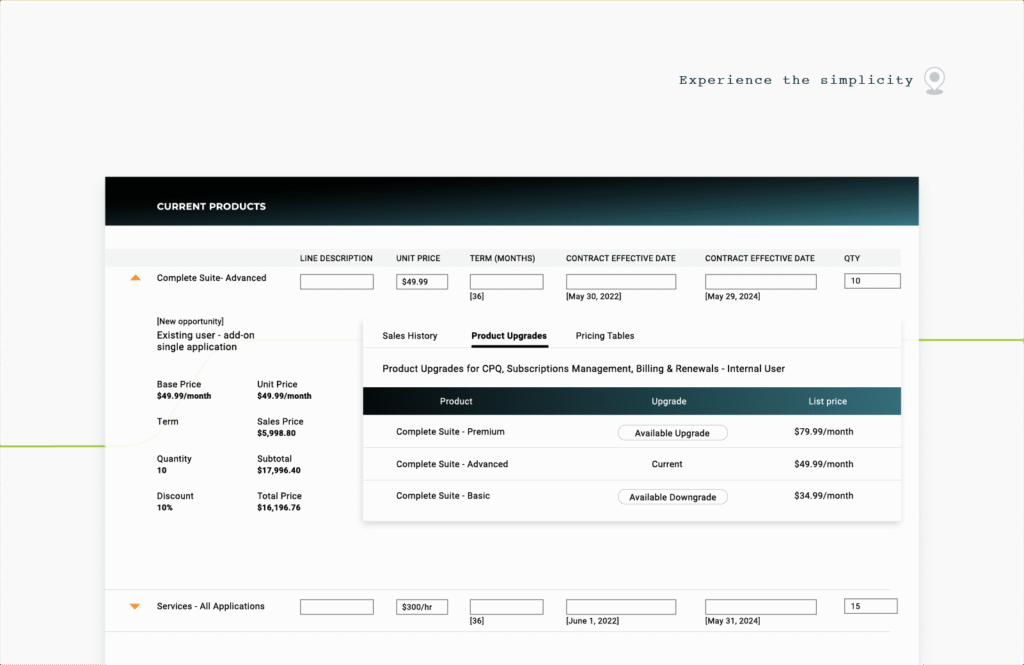
Salesforce revenue applications that incorporate these essential features enable businesses to streamline their revenue operations while maintaining the simplicity that many overcomplicated solutions lack.
In the realm of revenue management, many apps miss the mark by overcomplicating things.
Truth is, every Salesforce revenue app should start by nailing a few essentials.
Prioritize AI-driven revenue forecasting, real-time data integration, and automated processes for billing, subscriptions, and account planning. Get these right, and you’re set.
Flawless AI-Ready Data Drives Revenue Forecasting and Pipeline Analytics
Effective revenue management requires more than just guesswork; it demands precision. Flawless AI-Ready Data drives revenue forecasting and pipeline analytics, creating a different level of accuracy. Solutions like SAASTEPS employ a single-data model that captures all revenue lifecycle information within Salesforce, ensuring no data silos or leakage. This allows for precise forecasting and detailed pipeline analytics, enabling businesses to predict trends, optimize sales strategies, and accurately project future revenue.
Automated Billing, Invoicing, Subscription Management, and Renewals
Having a single platform that can handle all your billing, invoicing, subscription management, and renewals tasks helps future-proof businesses looking to streamline their revenue operations. Many companies struggle with these siloed data and manual processes that slow down their revenue lifecycle. Research shows that implementing formal control mechanisms through unified platforms can positively impact relationship continuity and revenue outcomes (Shin et al., 2021).
Automated billing, subscription management, and renewals are not luxuries but necessities for modern businesses and modern CPQs or Revenue Lifecycle Management solutions. These elements eliminate the headache of chasing payments, reducing human error, and ensuring timely renewals. With automated billing, you capture every billable moment, preventing revenue leakage.
Subscription management automates tasks like free trials, renewals, and reminders, making the process seamless and error-free. This integration not only saves time but also provides a unified view of your financial health, allowing for better decision-making and faster revenue velocity.
Transformation projects become simpler when you have structured data from the start, enabling smoother operations and scalable growth. Don’t let unstructured data systems hold you back; embrace automation and watch your revenue management transform.
Real-Time Data Integration and Cross-Departmental Collaboration
When it comes to managing revenue, siloed data and a lack of real-time integration can wreak havoc on your operations. Effective revenue management demands real-time data integration and cross-departmental collaboration. Without these, you’re flying blind. Teams struggle to align, leading to delays, miscommunication, and lost revenue.
SAASTEPS understands this pain. Our platform integrates all your revenue data in real time, ensuring everyone’s on the same page. Sales, finance, and operations can work together seamlessly, streamlining processes from CPQ to renewals. Say goodbye to data silos and hello to smooth, efficient workflows.
Don’t let disconnected data hold you back. Embrace real-time integration and cultivate collaboration to drive growth. Our non-provisional patent-pending solution accelerates transformation projects and unifies your revenue lifecycle from day one.
Complete revenue lifecycle management requires real-time perspectives and a unified view of metrics to support data-driven decisions. This integration guarantees transparent performance tracking, aligning teams and stakeholders around clear KPIs.
SAASTEPS ensures that all teams work with AI-ready data from day one, making complex transformations manageable and scalable. Whether your challenge is in quoting, billing, or renewals, our platform ensures that data is structured, accessible, and actionable across all departments.
Say goodbye to the chaos of ungoverned, siloed data and embrace the simplicity and efficiency of a unified revenue management system.
SAASTEPS: The Complete Salesforce Revenue Management Solution
SAASTEPS doesn’t just promise to streamline your revenue management; it commands every step of the process with sturdy automation, and intuitive and declarative to administer features.
This isn’t a tool for businesses seeking quick fixes; it’s an investment for leaders serious about overhauling their revenue lifecycle from the first handshake through the renewals lifecycle.
Let’s explore its core features, the impact it can have on your business, and what users think.
Core Functions and Automation Capabilities
- Quoting + Revenue Operations: SAASTEPS transforms the quoting process by structuring previously unstructured quote data into a single unified data model. With configurable bundles, price book segmentations, and deal desk management, Sales and RevOps can streamline workflows, organize revenue processes in one place, and ensure competitive pricing for faster deal closure.
- Billing, Invoicing + Payments: Structured revenue management data enables automation of billing, invoicing, and payments. This reduces manual errors, accelerates collections, and lowers Days Sales Outstanding (DSO), ultimately improving cash flow and operational efficiency.
- Subscription + Customer Success Management: Customer Success teams can easily manage subscriptions (extend, upgrade, downgrade, cross-sell, or add-on) through intelligent automation. With built-in auto-billing and auto-renewal capabilities, SAASTEPS minimizes churn, increases retention, and supports customer growth.
- AI-Ready Analytics + Reporting: By standardizing Salesforce revenue data, SAASTEPS creates flawless, AI-ready datasets. This powers Salesforce analytics with clear, customized revenue reports and dashboards, giving leaders real-time visibility and actionable insights across the entire revenue lifecycle.
Now let’s drill further into these Core Functions in more detail.
Quoting & Revenue Operations
The Pain: Traditional quoting often happens in spreadsheets, disconnected systems, or heavily customized Salesforce orgs. This leads to inconsistent pricing, slow approvals, revenue leakage, and deals stalling because Sales and RevOps lack a unified source of truth.
How SAASTEPS Core Functions Solve It:
- Single Data Model: SAASTEPS structures all quote data directly inside Salesforce, eliminating silos and custom integrations.
- Configurable Bundles: Sales reps can quickly build quotes with product bundles that adapt to customer needs (upgrade, swap, or remove products).
- Price Book Segmentation: Pricing rules and discounting strategies are centrally managed and segmented by market, region, or product line.
- Deal Desk Automation: Built-in workflows enable faster approvals, discount governance, and real-time visibility for managers.
The outcomes speak for themselves: Sales teams generate quotes in minutes, not days. RevOps gains control and consistency, while executives see reliable pricing and faster deal closures without adding headcount. The flawless AI-ready data is all sitting inside Salesforce, giving clear Dashboards and Reports.
Billing, Invoicing & Payments
The Pain: Disconnected systems, manual billing, and invoicing lead to errors, delayed collections, high DSO, and frustrated finance teams. Many companies juggle multiple tools for billing, payments, and ERP, which slows down cash flow and creates audit risks.
How SAASTEPS Core Functions Solve It:
- Automated Billing Engine: Invoices are generated automatically from approved quotes and subscriptions, ensuring accuracy.
- Integrated Payments with SAASPAY®: Credit cards, ACH, and global payment methods are natively embedded into Salesforce.
- Recurring Invoicing & Collections: Subscription charges, usage-based billing, and reminders are all automated.
- Compliance Built-In: Audit-ready data, tax handling, and revenue recognition are structured into the platform.
The outcomes speak for themselves: Finance reduces billing errors and closes the books faster. Cash comes in sooner, DSO drops, and the business gains complete visibility into revenue recognition without buying another ERP module, and all your data stays inside Salesforce.
Subscription & Customer Success Management
The Pain: Managing customer subscriptions is usually manual and fragmented; most commonly, data is spread across multiple spreadsheets, CRMs, billing systems, and renewal trackers. This creates churn risk, missed upsell opportunities, and poor customer experience.
How SAASTEPS Core Functions Solve It:
- Full Subscription Lifecycle: Automates extend, upgrade, downgrade, cross-sell, add-on, and cancel workflows inside Salesforce.
- Auto-Renewal Intelligence: Renewal quotes and invoices are automatically generated and sent to customers, reducing churn.
- Customer Portals: Customers can self-service their accounts, view invoices, and upgrade or add services instantly.
- Success Team Enablement: Customer Success has complete visibility into contract terms, usage, and billing history, all in Salesforce.
The outcomes speak for themselves: Renewals become a predictable revenue stream, churn decreases, and customers get a frictionless experience that encourages expansion. Customer Success teams can focus on relationships, not manual admin work.
AI-Ready Data Analytics & Reporting
The Pain: Disjointed systems and siloed data mean executives rely on lagging reports and inconsistent metrics. This limits forecasting accuracy, hides revenue leakage, and makes it impossible to prepare for the future of AI-driven revenue automation.
How SAASTEPS Core Functions Solve It:
- Structured Revenue Data: All transactions (quotes, orders, invoices, renewals) live in a single, standardized Salesforce data model.
- Pre-Built Dashboards: Executives get real-time dashboards for ARR, MRR, churn, pipeline-to-cash, and revenue forecasting.
- AI-Ready Foundation: Clean, structured data feeds predictive analytics and future AI automation (like CODEN™ voice-driven commands).
- Customizable Insights: Flexible reporting tools allow leaders to slice data by region, product, or segment without needing IT.
The outcomes speak for themselves: Executives gain confidence in forecasts, identify growth opportunities faster, and prepare their organizations for AI-driven automation. Decision-making moves from reactive to proactive.
Business Benefits and ROI Impact
SAASTEPS brings tangible benefits by directly tackling revenue leakage, ensuring every dollar is accounted for, and making revenue reporting and dashboards more precise.
It breaks down departmental barriers, speeding up deal closures and promoting teamwork.
Finally, it offers round-the-clock support, integrating seamlessly with customer success initiatives to keep operations running smoothly.
Reducing Revenue Leakage and Improving Recognition Accuracy
By integrating all revenue management processes into a single, unified platform, companies can address the persistent issues of revenue leakage and recognition accuracy. SAASTEPS directly addresses these challenges with its holistic approach.
- End-to-End Automation: Eliminates manual errors in contract lifecycle management.
- Real-time Tracking: Ensures precise revenue recognition from the moment a deal is signed.
- Unified Data Model: Reduces discrepancies in contract management processes.
- AI-Ready Data: Provides accurate insights to forecast and can turn on actionable data to autonomously manage your entire Revenue Lifecycle.
This unified platform transforms traditionally siloed, unstructured data systems into a streamlined, automated revenue lifecycle, notably enhancing overall efficiency and accuracy.
Cross-Departmental Collaboration and Deal Acceleration
Despite the promise of technology to break down barriers, many companies still struggle with siloed departments that slow down deal processes and hinder collaboration. Cross-departmental collaboration is essential for accelerating deals and ensuring smooth revenue management. Research shows that when cross-functional teams control processes from order initiation to after-sales service, they can improve first-time-right delivery rates from 65% to over 80% (Schaubroeck et al., 2016). By integrating processes from quoting to renewals, companies can streamline workflows and reduce the bottlenecks that hinder growth.
Utilizing SAASTEPS, businesses can enhance cross-departmental collaboration and deal acceleration. The platform’s unified data model eliminates the need for complex integrations, ensuring that all departments work from the same datasets. This synergy allows for faster decision-making and more efficient deal closures.
Below is a table outlining key benefits of SAASTEPS for cross-departmental collaboration and deal acceleration:
| Feature | Benefit | Impact |
| Unified Data Model | Consistent data across teams | Faster decision-making |
| No Custom Code Required | Simpler implementation | Quick time-to-revenue |
| AI-Ready Data from Day 1 | Better data insights | Enhanced forecasting |
| End-to-End Automation | Reduced manual tasks | Increased efficiency |
| Seamless Scalability | Flexible growth options | Scalable operations |
Using SAASTEPS, companies can transform unstructured, siloed data into clear, actionable perspectives. This transformation ensures that every department contributes to a seamless revenue lifecycle, driving growth and increasing operational speed.
Driving Revenue Velocity Through Unified Data Models
At SAASTEPS, we recognized early on that the key to successful revenue management lies in unifying the entire revenue lifecycle on a single platform. Through our work with numerous clients, we developed a Revenue Lifecycle Management (RLM) solution that eliminates data silos and integration challenges that typically plague revenue operations. Our approach focuses on maintaining consistent customer experiences and accurate revenue recognition across all products, channels, and pricing models.
Our commitment to streamlining operations led us to create a solution that reduced one client’s DSO from 30 days to just 2 days, demonstrating the power of unified revenue management. By implementing our single-data model approach, we’ve helped businesses achieve up to a 250% increase in revenue clarity and 5x faster decision-making capabilities.
24/7 Support and Customer Success Integration
Integrating support and customer success into the revenue lifecycle isn’t just about fixing problems; it’s about creating a seamless, prosperous customer journey. Practical support and customer success integration within revenue management systems ensures that every interaction enhances the customer experience.
This approach doesn’t just satisfy customers; it turns them into advocates. Here’s how SAASTEPS makes this happen:
- Proactive Support: Anticipate issues before they become problems, ensuring customers stay happy and loyal.
- Unified Data: Centralize all customer interactions in one place, eliminating silos and confusion.
- Real-time Perspectives: Give your team the tools to address customer needs instantly, with up-to-date information.
- Seamless Integration: Ensure that support and success efforts align perfectly with your revenue goals, driving growth.
This integration transforms customer service from a cost center into a revenue driver, setting SAASTEPS apart in the revenue management landscape.
How to Choose the Right Revenue Lifecycle Management App to Complement Your Salesforce CRM
Choosing a Revenue Lifecycle Management app to complement your Salesforce CRM starts with taking stock of where you currently stand. Assess the maturity of your revenue operations and set your business goals.
When evaluating different apps, don’t overlook the importance of integration capabilities and scalability; these factors can make or break your success.
Assess Your Revenue Operations Maturity and Business Goals
Before diving into the deep end of revenue lifecycle management apps, businesses must take a hard look at their end-to-end revenue operations. Evaluating your revenue lifecycle and revenue operations maturity is vital. Don’t jump into implementing new tools without understanding your current state. Many businesses make the mistake of adopting solutions that don’t fit their needs, leading to wasted resources and frustrated teams.
Here’s what you need to consider:
- Current Challenges: Identify specific pain points in your quoting, billing, and renewals processes. Where are you struggling the most?
- Future Goals: Define what you want to achieve. Are you looking to automate more of your revenue lifecycle, structure your unstructured data, or transform your operations?
- Maturity Level: Assess where you stand in terms of revenue operations maturity. Are you just starting, growing rapidly, or already established but needing optimization?
- Stakeholder Buy-In: Make sure that key decision-makers are on board. Getting buy-in from your CEO, CFO, or VP of Sales is essential for successful implementation.
Be honest about your current capabilities and future aspirations. SAASTEPS can help you unwind siloed, unstructured data systems and streamline your revenue lifecycle, but only if you’re ready to take that vital first step.
Evaluate Integration Capabilities and Scalability Requirements
When evaluating Revenue Lifecycle Management apps to complement your Salesforce CRM, businesses often overlook the critical aspects of integration capabilities and scalability requirements. These factors are essential for guaranteeing that the app can seamlessly fit into your existing systems and grow with your business needs. Here’s a quick comparison of what to consider:
| Feature | Integration Capabilities | Scalability Requirements |
| Ease of Use | Can it connect with other tools easily? | Will it handle more users later? |
| Data Management | Does it need custom code to integrate? | Can it manage increasing data loads? |
| Automation | Does it automate data syncing? | Will automation scale with growth? |
| Security | Does it maintain data security? | Can it guarantee security as you scale? |
| Implementation Time | How fast can it integrate? | Will it take longer to scale? |
Avoid apps that require extensive custom coding for integration; they’ll slow you down and cost more. Organizations that leverage open, extensible, and observable infrastructure build scalable AI systems that earn trust and drive adoption faster with less risk of uncontrolled sprawl (Sukharevsky et al., 2025). Ensure your chosen app scales seamlessly to accommodate more users and data without compromising performance. Remember, structured data from Day 1 ensures a smoother journey ahead. Don’t settle for tools that can’t keep up with your growth. Prioritize solutions that offer strong integration and scalability, enhancing your revenue lifecycle seamlessly.
Compare Pricing Models and Calculate Expected ROI
Comparing pricing models and calculating the expected ROI is a vital step when selecting a Revenue Lifecycle Management app to complement your Salesforce CRM.. You will find that different vendors offer varied pricing strategies that can profoundly impact your ROI.
Here are some key points to consider:
- Understand Upfront Costs: Look beyond the base price. Consider implementation fees, user licenses, and additional services. High initial costs mean fewer customizations later.
- Evaluate Long-Term Value: Assess how the app will grow with your business. A lower upfront cost might not be worth it if the solution can’t scale.
- Check for Hidden Fees: Beware of extra charges for integrations, support, or upgrades. Transparency in pricing is essential for accurate ROI calculations.
- Calculate Savings from Automation: Determine how much time and money you’ll save by automating processes like quoting, billing, and renewals. These efficiencies directly boost your ROI.
Review Implementation Timeline and Support Resources
While calculating ROI is essential, it’s not the only thing to contemplate when choosing a Revenue Lifecycle Management app to complement your Salesforce CRM. You must also scrutinize the implementation timeline and support resources. Many companies overlook these factors, leading to delayed projects and poorly handled issues.
SAASTEPS ensures a swift implementation timeline, getting your team up and running in just 4-8 weeks. This quick start doesn’t mean you’re left to fend for yourself afterward. We provide dependable support resources, offering configuration, deployment, and even a migration starter package.
Our platform grows with your needs, so you can start simple and scale up. Don’t underestimate the influence of prompt implementation and reliable support. It’s not just about getting started quickly; it’s about having a partner that ensures you’re never stuck or left behind.
Ask tough questions about onboarding and support when considering other apps. You’ll find that SAASTEPS doesn’t just promise, we deliver.
Frequently Asked Questions
How Does SAASTEPS Handle Payment Security?
SAASTEPS handles payment security through its unified payment processing solution, SAASPAY®, which includes fraud, security, and risk management services (PCI and DSS compliant). It eliminates negotiating with third-party gateways and manual handoffs, ensuring enterprise-grade security and uptime. The platform captures transaction data for smarter growth, adhering to stringent security protocols within its Salesforce-native architecture.
Does SAASTEPS Support International Payments?
Yes. SAASTEPS supports international payments through its SAASPAY® solution, enabling credit/debit and ACH payments worldwide to domestic accounts. For International payments, they have pre-built connectors with Stripe, Authorize, and CyberSource.
Can SAASTEPS Integrate With My Existing CRM Data?
Yes. SAASTEPS operates on a single-data model natively within Salesforce, allowing it to seamlessly integrate with existing CRM data without requiring additional integrations or custom code.
What Kind of Customer Support Does SAASTEPS Offer?
SAASTEPS offers dedicated customer support through various channels to address user inquiries and troubleshoot issues. Users can access a thorough knowledge base, submit support tickets, and engage with the support team via email and live Slack chat. Furthermore, SAASTEPS provides professional services for implementation, training, and optimization to guarantee customers maximize the platform’s capabilities.
Conclusion
When evaluating Revenue Lifecycle Management apps to complement your Salesforce CRM, remember that no single solution fits all. Don’t be swayed by shiny features, big brand names, or vendors that big investors back. First, honestly assess your business needs and gaps. Consider data structuring and automated workflows. Tools should unwind siloed systems, not create more. Be wary of unnecessary intricacy and stay focused on tools that drive fundamental transformation. With the right app, you’ll streamline operations, boost efficiency, and see precise results.
References
Schaubroeck, R., Holsztejn Tarczewski, F., & Theunissen, R. (2016, March 3). Making collaboration across functions a reality. McKinsey & Company. https://www.mckinsey.com/capabilities/people-and-organizational-performance/our-insights/making-collaboration-across-functions-a-reality
Shin, K., Amenuvor, F., & Boateng, H. (2021). Formal salesforce control mechanisms and behavioral outcomes. Marketing Intelligence & Planning, 39(7), 924-943. https://doi.org/10.1108/mip-11-2020-0470
Sukharevsky, A., Hjartar, K., & Kerr, D., et al. (2025, June 13). Seizing the agentic AI advantage. McKinsey & Company. https://www.mckinsey.com/capabilities/quantumblack/our-insights/seizing-the-agentic-ai-advantage