

[read time: 6 mins]
In modern revenue operations, leaders face a critical architectural fork in the road.
As revenue operations expanded across disconnected CRMs, spreadsheets, and General Ledger (GL) systems, a dangerous gap emerged; what industry thought leaders call the “Missing Mile.” This gap is where commercial promises made during sales quotes disconnect from financial reality, resulting in margin erosion, ungoverned “Shadow Finance,” and AI-generated projection errors (“Believable Slop”).
When solving this gap, software architecture falls into two fundamentally opposing camps:
- The External Integrated Control Plane: Platforms like servicePath™ build a separate, external middle layer designed to sit between multiple disparate CRMs (Salesforce, Microsoft Dynamics, HubSpot) and ERPs to govern quoting rules and cost calculations.
- The Simplified Native Unification: Solutions like SAASTEPS Revenue Lifecycle Management eliminate the gap entirely by unifying CPQ, Subscriptions, Billing, Invoicing, Payments, and Renewals on a single, 100% Salesforce-native data model.
While the external integrated model promises cross-CRM governance, modern growth leaders are discovering that a simplified, unified native architecture is superior for operational speed, cost efficiency, universal accessibility (from blind team members to autonomous AI agents), and true system ownership.
The Architectural Dilemma: Building bridges vs. eliminating gaps
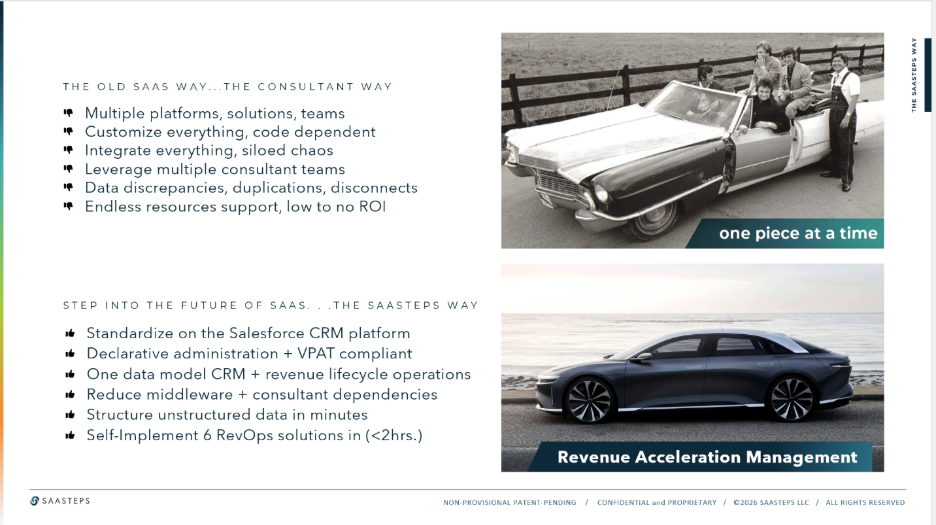
To understand why revenue teams are moving toward native simplicity, one must examine the cost of integration versus the power of unification.
External Integrated Model (e.g., servicePath™)
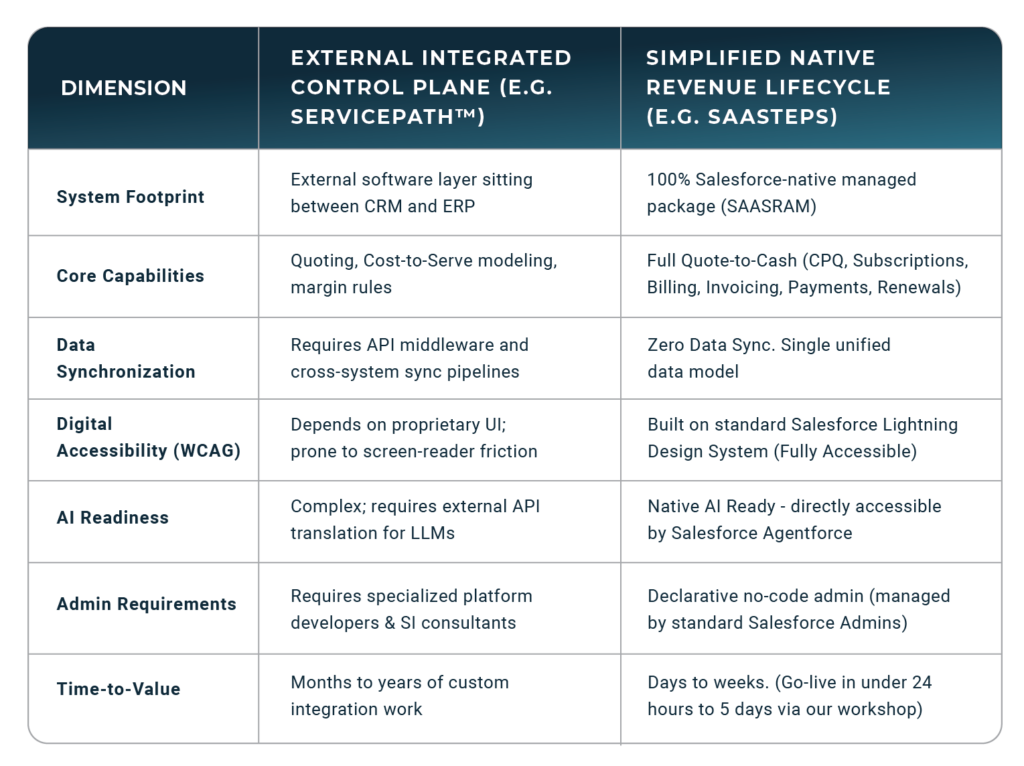
Salesforce / Dynamics / HubSpot CRM Platform → External RevOps Platform→ ERP / General Ledger Platform (API Syncs, Custom Logic, Middleware)
The High Cost of the “Integrated” Approach
An external control plane attempts to build a bridge over system gaps. However, every external bridge requires:
- Middleware and API Syncing: Data must pass back and forth between the CRM, the external CPQ engine, and the ERP, introducing latency, field-mapping breaks, and version drift.
- System Integrator (SI) Tax: Implementing and maintaining custom integration pipelines often costs $90,000 to $140,000+ per year in ongoing consulting fees.
- Siloed Execution: Quoting might be governed, but billing, payment processing, subscription adjustments, and renewals remain fragmented across downstream applications.
Simplified Native Model (e.g., SAASTEPS)
SALESFORCE PLATFORM CRM Opportunity → Commerce → CPQ → Contracts → Subscriptions → Billing & Invoicing → Payments → Autonomous Renewals → Revenue Command Center (No Sync, Declarative Admins, Single Native Data Model) + Agentforce
The Power of Native Unification
Instead of spending enterprise resources building and maintaining external bridges, the native approach brings the entire revenue lifecycle directly into the CRM.
By housing CPQ, Contracts, Subscriptions, Billing, automated invoicing, payment gateways (e.g., SAASPAY®), and contract renewals within standard Salesforce objects, there is zero data movement. The quote is the billing record; the subscription is the renewal opportunity. Commercial intent and financial execution reside in the exact same database, rendering revenue leakage physically impossible.
Universal Accessibility: Empowering everyone (including the blind and AI agents)
One of the most transformative advantages of simplified native architecture is democratized operational accessibility. When revenue management software relies on proprietary external interfaces, custom portals, or non-standard UI layers, it creates accessibility barriers for human workers and operational friction for AI systems.
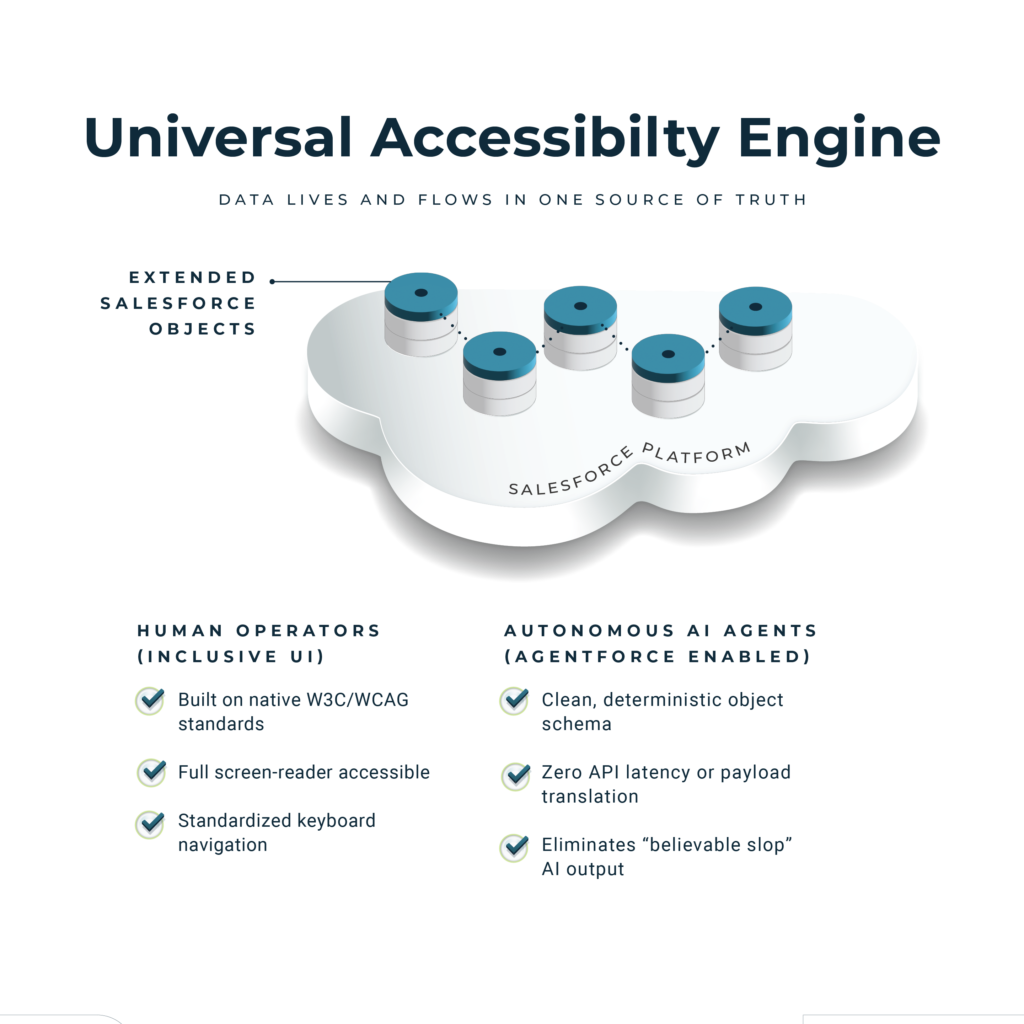
Human Accessibility: Enabling differently abled and visually impaired Workers
Enterprise compliance requires digital tools to adhere to strict accessibility standards (such as WCAG 2.1 AA and Section 508). External platforms often use custom JavaScript frameworks and non-standard canvas interfaces that break screen readers (like JAWS, NVDA, or VoiceOver) and keyboard-only navigation.
By building 100% natively on Salesforce Lightning, solutions like SAASTEPS inherit Salesforce’s world-class, accessible Lightning Design System (SLDS).
- Screen Reader Compatibility: Standard ARIA attributes and structured document object models ensure that visually impaired administrators, finance specialists, and sales reps can navigate complex quotes, billing schedules, and customer accounts seamlessly.
- Equal Opportunity RevOps: Operational workflows are simplified to standard declarative tasks, allowing anyone on the team (regardless of physical disability) to manage, execute, and monitor the entire revenue journey without specialized workarounds.
AI Accessibility: Enabling autonomous AI agents without “believable slop”
In 2026, enterprise AI has moved beyond simple text generation into Agentic Action (e.g., Salesforce Agentforce). However, AI agents are only as reliable as the data structures they interact with.
When an AI agent attempts to calculate margins or generate quotes across an external integrated system, it must parse unstructured API payloads, reconcile external rules engines, and guess pricing logic. This creates “Believable AI Slop” outputs that look authoritative but are mathematically untethered from unit economics.
Under a simplified native architecture:
- Deterministic Native Data: Pricing rules, discount tiers, and billing schedules reside on standardized Salesforce objects.
- Seamless Agent Execution: AI agents can read, calculate, and trigger quote-to-cash workflows directly within the CRM without translation layers.
- Traceable Audit Trails: Every automated decision made by an AI agent is instantly logged on native records, providing complete visibility for controllers and auditors.
The shift toward self-implementation workshops: taking direct charge of your growth journey
For decades, big brand name software vendors conditioned enterprise leaders to accept a painful status quo: Buy expensive software pay everything upfront, pay Consultants and System Integrators (SIs) twice the contract value to implement it, and wait 12 to 24 months to see value.
Today, revenue leaders are rejecting this legacy playbook.
Because simplified native architectures run on clean, declarative, no-code operating layer, which given forward-thinking CEOs, CFOs, and RevOps executives are having their Salesforce Architects, Salesforce Admins, or Business Admin attend a FREE 90-min Guided Self-Implementation Workshops to take full charge of their CRM and Revenue Lifecycle technology systems.
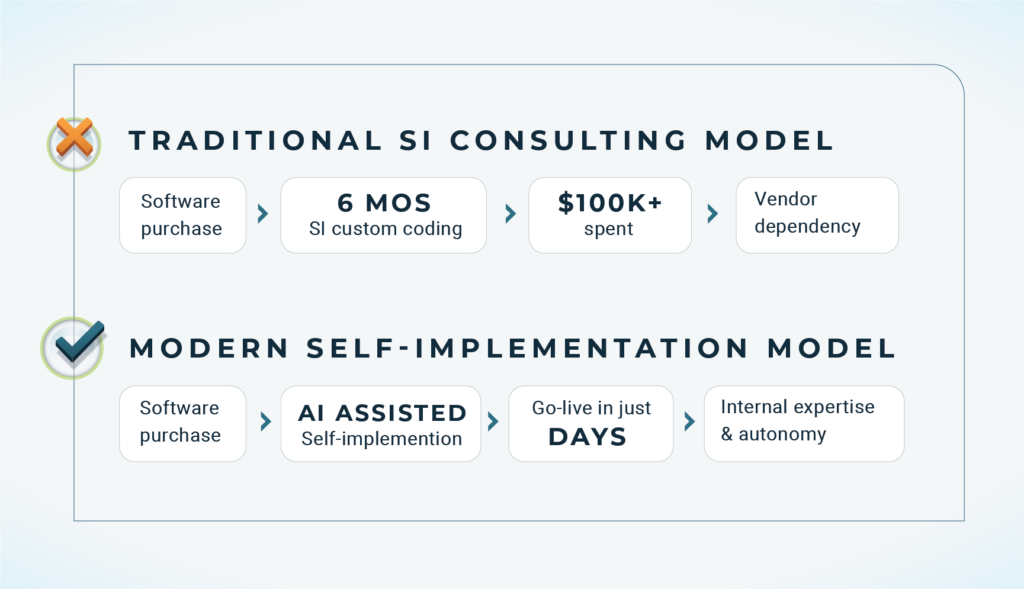
Why Businesses Are Choosing Self-Implementation:
- Eradicating the SI Tax: Companies save $90,000 to $140,000 annually by eliminating third-party consulting retainers and custom Apex developer dependencies.
- Building In-House Operational Expertise: Rather than handing system knowledge to external consultants who walk away when the contract ends, internal Salesforce administrators learn how to build, adjust, and optimize commerce, quoting, subscriptions, billing, invoicing, payments, and renewals themselves.
- Rapid Time-to-Revenue: In guided workshops (often conducted in dedicated sandbox environments), teams configure automated quoting, billing schedules, and renewal workflows in just 90-mins meeting, deploying a complete pre-configured solution almost immediately.
- Autonomous Agility: When pricing models or product catalogs change, internal teams can update declarative rules in minutes (without filing change requests with external SI vendors).
We believe – don’t build a bridge over the gap, just eliminate the gap
While external RevOps platforms like servicePath™ offer specialized margin modeling for complex, multi-CRM enterprise environments, they inherently perpetuate the multi-system fragmentation that created the “Missing Mile” in the first place.
For organizations aligned on Salesforce, SAASTEPS® proves that true operational excellence comes from native simplicity, structured, and standardized data model.
By unifying Commerce, CPQ, Subscriptions (Contracts), automated billing, invoicing management, payment gateways, and renewals into a single native data model, businesses gain:
- Zero revenue leakage through a unified Revenue Command Center.
- Universal operational accessibility for all employees, including blind team members using native screen readers, and AI.
- Hallucination-free AI automation powered by clean, deterministic native records.
- Complete self-sufficiency through guided self-implementation workshops that put revenue teams back in complete control of their systems and growth journey.
The future of revenue operations isn’t about managing complex integrations; it’s about building an accessible, autonomous, and unified revenue engine that works seamlessly for everyone.
SAASTEPS is a non-provisional patent pending technology, who focuses on reducing CRM complexity for businesses and seamlessly streamlining their Revenue Lifecycle into a single data model, that can be self-implemented.
SAASTEPS Registered Trademarks:
- SAASTEPS® (Step into SAAS, a Single Data Model)
- SAASPAY® (Commerce + Payments)
- SAASRAM® (Revenue Acceleration Management)
- CODEN® (Revenue Lifecycle AI Concierge)