

(read time: 4 mins)
In the early stages of your company’s growth journey, spreadsheets often feel like a lifeline. They are flexible, familiar, and seemingly free. Founders proudly track their first ten, then fifty, customers in Excel or Google Sheets, believing they are saving money by avoiding “expensive” software. However, as subscriber counts climb, this manual approach transforms from a cost-saving measure into a silent revenue leak. The true cost of manual billing isn’t just the time spent data entry; it is the cumulative impact of errors, churn, and stalled growth.
The hidden labor tax
The most visible cost of manual billing is labor. What begins as a monthly task for the founder quickly devolves into a multi-day ordeal involving finance, support, and engineering teams. Consider the workflow: generating invoices, emailing them individually, tracking payments in a bank feed, updating the spreadsheet, sending reminders for late payments, and manually reconciling discrepancies.
As the customer base grows, this process does not scale linearly; it scales exponentially. A team that could manage 50 customers in a few hours might require days to manage 500. This is time stolen from product development, marketing strategy, and customer success. When highly paid employees spend their weeks acting as human invoicing machines, the opportunity cost becomes staggering.
The revenue leak of human error
Spreadsheets are notorious for their fragility. A misplaced decimal, a broken formula, or an accidental overwrite can have disastrous financial consequences. In a manual billing environment, errors are not just annoyances; they are direct hits to the bottom line.
Common mistakes include:
- Underbilling: Forgetting to charge for add-ons or usage overages.
- Delayed Invoicing: Sending invoices late results in late payments, disrupting cash flow.
- Failed Retention: Missing a renewal date because it wasn’t flagged, leading to involuntary churn.
Studies suggest that manual data entry has an error rate of roughly 1% to 4%. In subscription billing, even a 1% error rate can represent significant lost revenue annually, not to mention the administrative cost of fixing the mistake and the potential damage to customer trust.
The churn catalyst
Perhaps the most damaging cost of manual billing is its effect on customer retention. Modern consumers expect a seamless, Amazon-like experience. They expect instant receipts, self-service portals to update credit cards, and clear billing histories.
When a customer has to email support to ask for an invoice, wait 24 hours for a reply, or navigate a confusing payment link sent via email, friction is introduced. Friction is the enemy of retention. If a payment fails due to an expired card and there is no automated dunning system to nudge the customer to update their details, that subscription cancels itself. Involuntary churn caused by manual payment failures is often the silent killer of SaaS growth, yet it is entirely preventable.
Manual vs automated: A reality check
To visualize the divergence between staying manual and embracing automation, consider this comparison of operational realities:
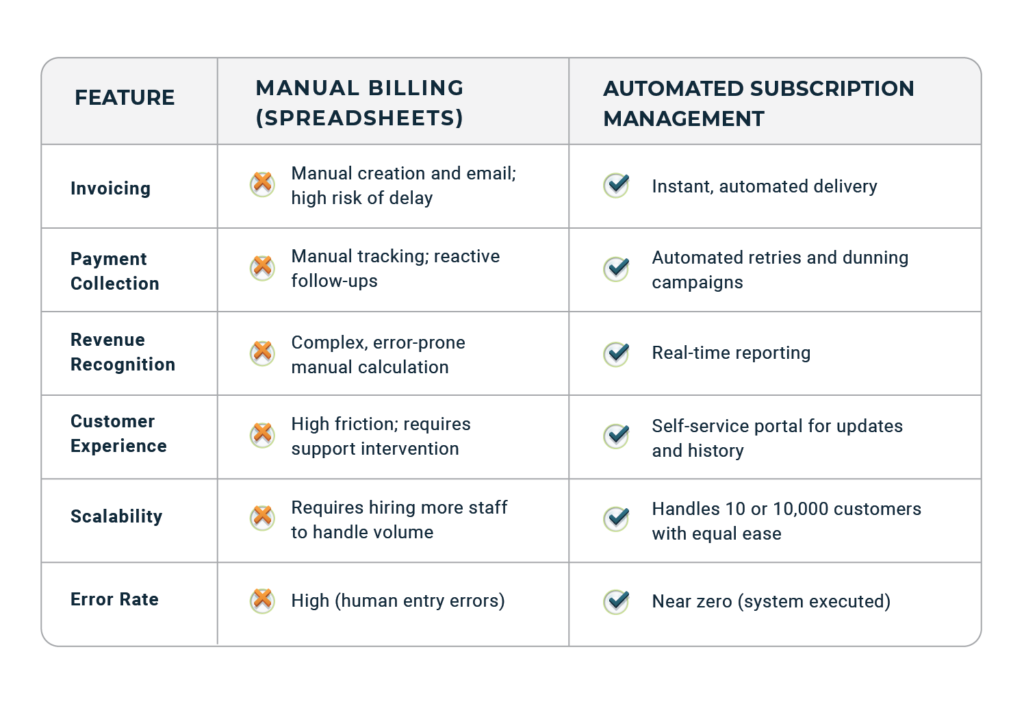
Reclaiming focus for growth
The transition away from manual processes is rarely about buying software; it is about buying back time and securing revenue. When billing runs on autopilot, finance teams shift from data entry to strategic analysis. Support teams stop answering “Where is my invoice?” tickets and start solving actual product issues. Founders stop worrying about cash flow gaps caused by late payments and start focusing on the next feature release. Automation provides the infrastructure necessary to scale without breaking. It ensures that as you add customers, your operational overhead remains flat while your reliability increases.
The strategic shift
Moving away from spreadsheets doesn’t require an enterprise-level overhaul that takes months to implement. The modern landscape offers agile solutions designed specifically for growing SaaS companies that need reliability without the bloat.
This is where SAASTEPS enters the conversation. Rather than forcing a complex migration or locking you into rigid contracts, SAASTEPS offers a streamlined approach to subscription management that bridges the gap between messy spreadsheets and overly complicated enterprise ERPs. It handles the heavy lifting of recurring billing, tax compliance, and dunning management, allowing your team to focus on what they do best: building a great product.
By treating billing as a strategic asset rather than an administrative chore, companies can unlock the growth potential that manual processes have been holding back.
The question is no longer whether you can afford to automate, but whether you can afford the hidden costs of staying manual. It’s time to Software Differently.