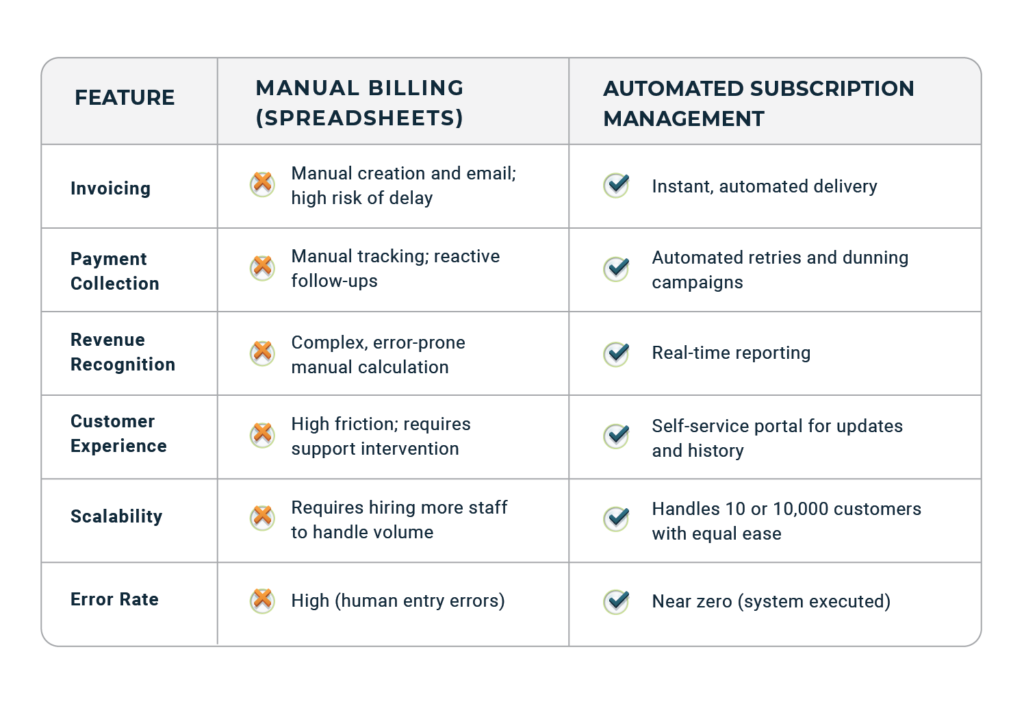
Every time your team processes bills by hand, money slips through the cracks. Behind those simple paper invoices lies a hidden drain on your business, from the apparent costs of materials to the not-so-obvious hours your staff spends typing data and fixing mistakes. These small issues snowball into late payments and frustrated customers. But here’s the good news: switching to automated billing not only saves money but also makes your billing process smoother and keeps your customers smiling. Ready to calculate how much manual billing costs your business?
Why Trust Our Revenue Management Expertise?
At SAASTEPS, we’ve been at the forefront of revenue lifecycle management since 2012, transforming how businesses handle their billing and subscription processes. Our co-founders, Tim Beck and Ron Costa, bring over two decades of industry experience, during which they’ve witnessed firsthand the challenges and hidden costs of manual billing systems that we’ve discussed in this article. This deep understanding has led to our development of a non-provisional patent-pending solution that has helped countless businesses eliminate revenue leakage and streamline their entire billing operations.
Our expertise isn’t just theoretical – we’ve built a comprehensive platform that directly addresses the pain points mentioned above. Through our work with startups, SMBs, and growing SaaS businesses, we’ve developed innovative solutions that have consistently demonstrated the real-world impact of automated billing systems. Our single-data model approach, which requires no integrations or custom code, has been specifically designed to overcome the common challenges of manual billing that we’ve outlined in this article.
Understanding The Direct Manual Billing Costs Impacting Your Bottom Line

Manual billing processes can create hidden expenses through administrative labor, paper costs, storage requirements, and error correction, which significantly impact operational profitability.
Did you know that every manually processed invoice costs you more than just time? Each invoice encompasses labor expenses, materials, overhead, and processing fees that quickly add up.
When comparing manual versus automated processing, the cost per invoice can be surprisingly high, making it essential to closely examine these expenses.
Labor Expenses And Time Investment Per Invoice
When considering manual billing, many businesses underestimate the actual cost of labor expenses and time invested per invoice. The reality is that manual processes demand significant time and resources, which can severely impact operational efficiency.
Each invoice requires meticulous data entry, verification, and potential corrections, all of which add up to considerable labor costs. Additionally, manual billing often leads to errors that necessitate further time and effort to rectify, driving costs even higher.
Businesses often find that the time invested in these manual tasks could be better spent on strategic activities that drive growth. Switching to automated billing solutions not only reduces these labor expenses but also enhances accuracy and speed, providing a clear path to improved operational efficiency and scalability.
Materials, Overhead, And Processing Cost Breakdown
How much does manual billing cost your business? The expenses go far beyond just labor. Materials such as paper, ink, and postage for invoices can add up quickly.
Overhead costs such as manual data entry, storage, and office supplies also contribute to the burden. Don’t forget to account for processing costs, including banking fees, check handling, and reconciliation efforts.
These combined costs can seriously dent your bottom line. With manual billing, every invoice requires physical resources and administrative tasks that automation could eliminate.
Don’t let unnecessary operating costs hold you back. Transform your billing process to save time, reduce errors, and cut these hidden expenses.
It’s time to take control and streamline your revenue lifecycle.
Cost Per Invoice: Manual Vs Automated Processing
Every invoice your business generates involves costs, but these expenses can vary significantly depending on whether you use manual or automated processing. Manual data entry, while seemingly straightforward, incurs significant costs.
These include:
- Labor Costs: Employees spend hours entering data, checking for errors, and handling corrections.
- Error Rates: Manual entry is prone to mistakes, leading to costly reprints, reshipments, and customer dissatisfaction.
- Delayed Payments: Invoices sent late due to manual processing can cause delays in payments, impacting cash flow.
- Storage Costs: Physical invoices require storage space, adding to overhead costs.
Automation software, like SAASTEPS, eliminates these issues. It reduces labor costs, minimizes errors, ensures timely invoicing, and eliminates the need for physical storage.
The cost per invoice considerably decreases, directly improving your bottom line. Moving to automated processing is not just about cost savings; it’s about streamlining operations for scalable growth.
Hidden Risks And Expenses Of Manual Billing Systems
Manual billing systems harbor hidden risks that go beyond obvious inefficiencies. Errors, often attributed to human oversight, lead to costly corrections and cash flow disruptions, especially when payments are missed or delayed.
These systems also expose businesses to data privacy risks and regulatory compliance issues, all while contributing to employee burnout and the misallocation of essential resources.
Human Error Rates And Correction Costs
The hidden risks and expenses of traditional billing systems often go unnoticed, but they can seriously impact a company’s bottom line. Human error rates in manual processes are a notable concern. These errors aren’t just minor inconveniences; they can lead to substantial financial losses and operational inefficiencies. Companies that switch to automated systems have seen significant improvements, with research showing that automated lifecycle management systems lead to faster product delivery times (Egan & Haynes, 2019).
- Inaccurate Invoicing: A simple typo or miscalculation can result in incorrect billing amounts, leading to undercharging or overcharging customers.
- Delayed Payments: Errors in manual billing can cause delays in payment processing, affecting cash flow and financial planning.
- Customer Dissatisfaction: Incorrect or late invoices can frustrate customers, potentially leading to churn and damage to their reputations.
- Correction Costs: Fixing these errors requires additional time and resources, diverting attention from core business activities.
Addressing these issues requires a shift from manual processes to automated solutions, such as SAASTEPS, which streamlines billing and subscription management, thereby reducing human error and enhancing overall efficiency.
Cash Flow Delays And Missed Payment Discounts
Beyond the immediate issues of human error, manual billing systems present another considerable challenge: cash flow delays and missed payment discounts. Manual payment processes often result in late invoices and delayed payments, leading to substantial disruptions in cash flow. When invoices aren’t sent on time, payments are inevitably delayed, leading to a domino effect on a company’s financial stability.
Missed payment discounts are another hidden cost. Early payment discounts are common incentives to encourage prompt payments. However, manual billing inefficiencies often cause companies to miss out on these discounts, resulting in unnecessary expenses.
Streamlined, automated billing systems, such as those provided by SAASTEPS, eliminate these delays and ensure that every discount opportunity is captured, thereby enhancing overall cash flow and financial health. Proper management of these processes transforms a company’s financial operations, reducing the risks associated with manual billing and subscription management.
Data Privacy And Regulatory Compliance Vulnerabilities
How often do companies consider the hidden risks of manual billing systems, particularly when it comes to data privacy and regulatory compliance? Manual processes expose businesses to considerable vulnerabilities that automated systems mitigate. The use of automated systems has demonstrated superior risk management capabilities, with studies showing they can identify and address potential weaknesses more effectively than manual processes (Lavens et al., 2022).
- Sensitive Data Exposure: Paper invoices and emails containing payment information can easily fall into the wrong hands, increasing the risk of payment fraud.
- Human Error: Manual data entry is prone to mistakes, leading to incorrect billing and potential non-compliance with regulations.
- Regulatory Compliance: Keeping up with ever-changing regulations is a challenging task. Manual systems may struggle to adjust swiftly, putting the company at risk of fines and legal issues.
- Data Silos: Information scattered across different platforms makes it hard to ensure consistency and compliance, creating gaps that can be exploited.
Automating these processes not only secures data but also guarantees that every transaction complies with the latest regulations, safeguarding your business from hidden risks and expenses.
Employee Burnout And Opportunity Cost Of Misallocated Resources
Manual billing systems pose not only data privacy risks but also drain precious employee resources. They involve repetitive tasks and manual processes that lead to considerable employee burnout. Every hour spent on data entry, invoice generation, and payment tracking is an hour not spent on strategic tasks, such as customer engagement or growth initiatives. The financial impact is substantial, with manual billing systems contributing to high administrative costs that could be reduced by $200 billion to $360 billion annually through automation and analytics (Baxi et al., 2023).
This misallocation of resources hampers productivity and innovation. Employees bear the brunt of these inefficiencies, often resulting in decreased job satisfaction and higher turnover rates. For businesses aiming to transform and automate their revenue lifecycle, these hidden costs are substantial barriers.Automating billing and subscription management not only reduces operational strain but also allows teams to focus on higher-value activities that drive growth and customer retention. Research indicates that the proper implementation of automation tools enables organizations to achieve significant cost savings in operational expenditures while minimizing employee adaptation time to new workflows (Al-Amin et al., 2024). SAASTEPS addresses these challenges head-on, providing a unified, streamlined solution that minimizes manual efforts and maximizes efficiency.
SAASTEPS: Transforming Manual Billing Through Innovation
When developing SAASTEPS billing and invoicing software, we recognized that businesses needed more than just automation – they needed a comprehensive solution that could scale with their growth. Our approach focused on creating a 100% Salesforce-native application that complements and extends the core Salesforce objects, eliminating revenue leakage and streamlining the entire billing process. Through careful consideration of real-world challenges, we designed a system that not only automates invoice creation and delivery but also provides real-time synchronization between sales, billing, and payments, all while maintaining the simplicity that growing businesses need.
Modern Solutions: AI-Powered Automation And Strategic Implementation
The shift to modern solutions has sparked a conversation around AI-powered automation and strategic implementation for managing billing and subscriptions. These modern tools promise to root out errors, prevent churn, and transform operations by learning as they go.
However, here’s the catch: without strong change management and the right scalable solution, companies will struggle to achieve the promised ROI.
Machine Learning For Error Detection And Churn Prevention
Despite rapid advancements, many businesses continue to struggle with error-prone manual processes and high customer churn rates. Traditional manual data entry methods often lead to mistakes, resulting in increased operational costs and dissatisfied customers.
By implementing machine learning, businesses can detect and correct these errors before they cause significant harm. Machine learning also plays a crucial role in preventing churn. It identifies patterns and predicts which customers are likely to churn, enabling proactive measures to retain them.
ROI Analysis: Cost Savings And Efficiency Gains From Automation
After exploring how machine learning can prevent errors and reduce churn, it’s time to scrutinize the tangible benefits of automation. The truth is, manual processing drains resources. It’s slow, error-prone, and eats up precious time that could be spent on strategic tasks.
With automation, you slash operating costs and boost efficiency. Take billing, for instance. Manual billing means paying someone to create, send, and track invoices. Automation handles that instantly, no extra hands needed. That’s real cost savings.
Plus, automation ensures accuracy, reducing errors that cost time and money to fix. It streamlines workflows, making your team more productive.
With SAASTEPS, you transform manual processes into automated workflows, boosting efficiency and driving notable cost savings from day one. Don’t let manual tasks hold you back; embrace automation and watch your ROI soar.
Integration With ERP Systems And Emerging Payment Technologies
Integrating ERP systems and emerging payment technologies poses a substantial challenge for many businesses today, often leading to clunky processes and stalled growth. Traditional ERP systems weren’t built for the modern needs of SaaS companies, causing friction in payment systems and data silos. This results in manual workarounds that waste time and money.
Here’s where things go wrong:
- Delayed Payments: Manual processes slow down automatic payments, causing cash flow issues.
- Data Silos: Information gets stuck in different systems, leading to errors and missed opportunities.
- Complexity: Multiple systems mean more places for things to go wrong, like mismatched data or failed transactions.
- Lack of Flexibility: Old systems can’t handle new payment methods or subscription models, limiting growth.
At SAASTEPS, we simplify this. Our platform unifies your revenue lifecycle, from quoting to renewals, all within Salesforce. No more juggling different tools or chasing payments.
We make sure your data is AI-ready from day one, so you can focus on what matters: growing your business.
Change Management And Scalable Solution Selection
How do you pivot from traditional, disjointed revenue management to a streamlined, scalable solution? Change management is key. Many businesses cling to outdated methods, fearing disruption. However, those who embrace transformation discover that streamlined change releases potential.
Start with a rigorous assessment. Identify bottlenecks in quoting, billing, and renewals. Highlight inefficiencies hampering growth. Think end-to-end automation. Scalable solution selection means choosing software that grows with you. Don’t settle for point solutions that tackle one area.
Platforms like SAASTEPS, 100% Salesforce-native, address the entire revenue lifecycle.
Engagement tools and data analytics convert reluctance into conviction. Leverage scalable solutions providing real-time insights and automated processes. Ensure data is structured and AI-ready from day one.
Change isn’t easy, but it’s essential. Resistance wastes time; accept disruption, promote innovation. Traditional methods drain resources; unified platforms save them. Pivot wisely.
Frequently Asked Questions
How Much Time Can Automation Save My Finance Team?
Automation reduces the time a finance team spends on repetitive tasks. With SAASTEPS, manual processes like billing, invoicing, and subscription management are streamlined. This eliminates human error and guarantees timely payments, saving the finance team considerable hours each month.
What Are the Upfront Costs of Implementing Automated Billing?
The upfront costs of implementing automated billing include the price of the RLM Priority Plus Bundle or Quick Start Services at SAASTEPS, which may involve a single initial fee for a 4-8 week implementation and user licenses. Interested organizations may opt for a free trial to assess the solution’s value before committing.
Can Automated Systems Handle Complex Pricing Structures?
Automated systems can handle complex pricing structures. SAASTEPS’ Quoting/CPQ solution dynamically adjusts pricing in real-time, manages complex configurations, and supports various pricing models, including subscriptions, usage-based, and hybrid offerings. The platform also provides detailed perspectives for optimizing pricing strategies.
How Does Automated Billing Improve Customer Satisfaction?
Automated billing enhances customer satisfaction by ensuring timely, accurate invoicing, reducing erroneous charges, and providing a seamless payment experience. It also enables customers to have a clear, all-encompassing view of their charges, minimizing disputes and inquiries, and allows for easier account management.
What Kind of Support Is Available During Transition to Automated Systems?
Support during the shift to automated systems includes a demo of the new platform, an assessment to identify current inefficiencies, and a free trial for hands-on experience. Implementation services are also available for a fee, providing configuration and deployment assistance within 4-8 weeks.
Conclusion
Manual billing and subscription management may save money, but they waste time and resources. They lead to mistakes, slow down payments, and frustrate customers. Automated systems, like those offered by SAASTEPS, fix these problems. They help businesses grow, keep customers happy, and save money in the long run. It’s time to ditch manual processes and embrace automation.
References
Al-Amin, K., Ewim, C., Igwe, A., & Ofodile, O. (2024). AI-driven end-to-end workflow optimization and automation system for SMEs. International Journal of Management & Entrepreneurship Research, 6(11), 3666-3684. https://doi.org/10.51594/ijmer.v6i11.1688
Baxi, S., Parikh, S., & Peterson, M. et al. (2023, July 25). Automation, analytics and AI in revenue cycle management. McKinsey & Company. https://www.mckinsey.com/industries/healthcare/our-insights/setting-the-revenue-cycle-up-for-success-in-automation-and-ai
Egan, D., & Haynes, N. (2019). Manager perceptions of big data reliability in hotel revenue management decision making. International Journal of Quality & Reliability Management, 36(1), 25-39. https://doi.org/10.1108/ijqrm-02-2018-0056
Lavens, E., Philippaerts, P., & Joosen, W. (2022). A quantitative assessment of the detection performance of web vulnerability scanners. In Proceedings of the 17th International Conference on Availability, Reliability and Security (pp. 1-10). https://doi.org/10.1145/3538969.3544416